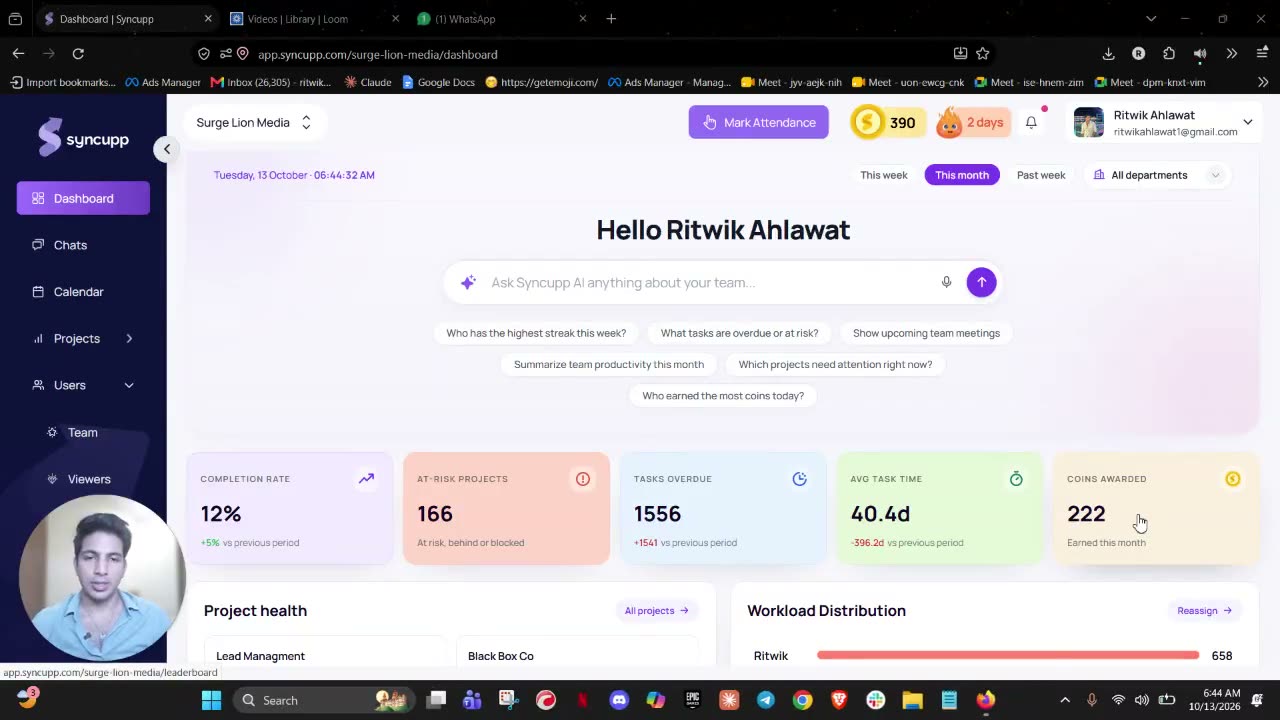
Workplace Accountability Statistics 2026: Data + What Works
Most teams have a follow-through problem, not a motivation problem. Here are the newest workplace accountability statistics, each traced to its original publisher, and the fixes the evidence supports.

On this page
- Workplace accountability statistics at a glance
- How big is the accountability gap in 2026?
- Do employees know what is expected of them?
- How much time do teams lose chasing task updates?
- How often do projects miss deadlines or fail?
- Does recognition improve accountability?
- Does gamification improve accountability at work?
- Which accountability statistics should you stop quoting?
- What actually improves team accountability?
- How do you measure accountability on your team?
- Frequently asked questions
- Conclusion: accountability is a system, not a speech
- About Syncupp
- Sources
Most teams do not have a motivation problem. They have a follow-through problem: a task gets assigned in a meeting or a chat, then goes quiet until the deadline slips. This page collects the newest workplace accountability statistics, each traced to its original publisher, and shows which fixes the evidence supports.
Workplace accountability statistics at a glance
Every figure below was checked on the publisher's own page in November 2026. Sources are linked in each section.
| # | Statistic | Source (data year) |
|---|---|---|
| 1 | "Create accountability" is the lowest-rated of 7 leadership competencies | Gallup (2025 survey, published 2026) |
| 2 | Only 30% of managers rate their leader exceptional at creating accountability; 46% of leaders rate themselves that way | Gallup (2025) |
| 3 | Clarity about what is expected at work fell 9 points from 2020 to 2025, the largest drop of any engagement item for US employees | Gallup (2025) |
| 4 | Global employee engagement fell to 20% in 2025 | Gallup State of the Global Workplace 2026 |
| 5 | Manager engagement dropped from 27% to 22% in one year | Gallup (2024–2025) |
| 6 | Low engagement cost the world economy about $10 trillion in lost productivity | Gallup (2025) |
| 7 | Heavily pinged workers are interrupted every 2 minutes, 275 times a day | Microsoft Work Trend Index (2025) |
| 8 | Teams waste 25% of their time searching for answers | Atlassian State of Teams (2025) |
| 9 | 58% of the workday goes to "work about work" | Asana Anatomy of Work (2022 data) |
| 10 | 31% of complex projects miss their full intended benefits, vs 13% of projects overall | PMI Pulse of the Profession (2026) |
| 11 | Only 22% of employees get the right amount of recognition | Gallup and Workhuman (2024) |
| 12 | Well-recognised employees are 45% less likely to leave within two years | Gallup and Workhuman (2024) |
| 13 | 80% of employees who got meaningful feedback in the past week are fully engaged | Gallup (2023) |
| 14 | Gamification has a small-to-medium positive effect on motivation (g = 0.36) | Sailer & Homner meta-analysis (2020) |
How big is the accountability gap in 2026?
Accountability is the leadership skill employees rate lowest. In a 2025 Gallup survey of 23,068 US adults, "create accountability" ranked last of seven competencies for both managers and senior leaders. Only 30% of managers said their leader is exceptional at it, while 46% of leaders gave themselves that rating.
That 16-point perception gap matters. Leaders think they are holding people to commitments; the people below them disagree. Gallup also found that managers whose leaders excel at accountability are three times as likely to be engaged: 51% versus 17% (Gallup, 2026).
The takeaway for small teams: accountability is not a personality trait you hire for. It is a system leaders build, and most leaders believe theirs works better than it does.
Do employees know what is expected of them?
Fewer than they used to. Gallup reports that clarity about what is expected at work fell nine points among US employees between 2020 and 2025, the largest decline of any item in its engagement index. Managers and individual contributors with this clarity are nearly four times as likely to be engaged as those without it (Gallup, January 2026).
Among people managers, the gap is stark: 71% of those with clear performance expectations are engaged, against 19% of those without. You cannot hold someone accountable for an outcome they never clearly agreed to.
The wider picture is falling, too. Gallup's State of the Global Workplace 2026, based on 263,810 respondents, puts global engagement at 20% in 2025 (Gallup data summary, 2026). It estimates low engagement cost the world economy about $10 trillion in lost productivity, or 9% of GDP, and reports manager engagement fell from 27% to 22% in a single year (Gallup, 2026).
Manager engagement fell 9 points since 2022, to 22%
Share of employees engaged at work, worldwide. Vertical scale starts at 10%.
Managers lost engagement more than twice as fast as employees overall, and managers are the people expected to create accountability.
How much time do teams lose chasing task updates?
A lot, and most of it is spent asking where things stand. Atlassian's State of Teams 2025, a survey of 12,000 knowledge workers and 200 executives, found that leaders and teams waste 25% of their time searching for answers. Microsoft telemetry shows the most heavily pinged workers are interrupted every two minutes during core hours.
The Microsoft figures come from its June 2025 Work Trend Index, which combined Microsoft 365 usage data with a survey of 31,000 workers in 31 markets:
- The average worker receives 117 emails a day and 153 Teams messages per weekday.
- For the top 20% of users by message volume, a meeting, email or chat arrives every two minutes in core hours: 275 interruptions a day (Microsoft WorkLab, 2025).
- Meetings after 8 pm were up 16% year over year.
Asana's Anatomy of Work Global Index found knowledge workers spent 58% of their day on "work about work", Asana's term for coordinating work rather than doing it (Asana via Business Wire, 2023). Note the date: that survey ran in November 2022 and is the latest edition published, so treat it as a benchmark, not a 2026 reading.
What this means: when progress lives in people's heads and chat threads, managers have to ask for it. Every "any update on this?" message is an interruption for the asker and the person asked (Atlassian, 2025).
How often do projects miss deadlines or fail?
More often as work gets more complex. PMI's Pulse of the Profession 2026 found that 31% of complex projects fail to deliver their full intended benefits, more than twice the 13% rate for projects overall. 81% of project professionals say projects have become more complex (PMI, May 2026).
How teams manage that complexity decides the outcome. In the same report, teams that handle complexity effectively delivered an 88% success rate, against 14% for teams rated only slightly effective or ineffective.
Schedules slip even for strong teams. In PMI's 2025 report, based on 2,841 project professionals, projects led by people with high business acumen finished on their initial schedule 63% of the time, versus 59% for everyone else (PMI Pulse of the Profession 2025, PDF). Put plainly, roughly four in ten projects miss their original timeline.
For a 10-person team, the lesson is practical: deadlines slip in the gaps between people. A task with no single owner, no visible due date, or no check-in point is where most delays start.
Does recognition improve accountability?
Yes. Recognition is the feedback half of accountability, and most employees do not get enough of it. A Gallup and Workhuman study found just 22% of employees get the right amount of recognition, and well-recognised employees were 45% less likely to have left after two years (Gallup, 2024).
The study tracked about 3,500 employees from 2022 to 2024. It also found that employees whose recognition met four or more of its "pillars" of good recognition were far more likely to be engaged: 90% versus 10%.
Frequency matters as much as quality. Gallup reports that 80% of employees who received meaningful feedback in the past week are fully engaged, yet only 16% said their last conversation with their manager was extremely meaningful (Gallup, updated 2026). Weekly beats annual.
With each lever in place, engagement is 3 to 9 times higher
Share engaged at work, with vs without each lever. Gallup US data, 2022 to 2025.
Manager says their leader excels at creating accountability
17%51%3.0xPeople manager has clear performance expectations
19%71%3.7xRecognition meets 4 or 5 of Gallup's pillars (vs none)
10%90%9.0x
The pattern across all three is the same. Accountability works when people know the target, see their progress and get credit when they hit it. Remove any one of those and engagement collapses.
Does gamification improve accountability at work?
The evidence is positive but modest, and mostly from learning settings. A peer-reviewed meta-analysis by Sailer and Homner (2020) found gamification has a small-to-medium effect on motivation (g = 0.36, 16 studies, 2,246 participants) and a smaller effect on behaviour (g = 0.25) (Educational Psychology Review, 2020).
How to read that honestly:
- It works as a nudge, not a cure. Points and streaks make the right behaviour, such as updating a task, more visible and more rewarding. They do not fix unclear goals.
- The research is mostly in education. Workplace-specific trials are fewer, so treat strong vendor claims with care.
- Design matters. Rewarding completion and on-time updates supports accountability. Rewarding raw activity can encourage busywork.
A related finding is often misquoted. Dominican University's goal study by Gail Matthews reported that more than 70% of participants who sent weekly progress updates to a friend achieved their goal, versus 35% of those who kept unwritten goals to themselves (Dominican University, 2016). It was a small, four-week study of 149 completers, but the direction is consistent with Gallup: visible progress plus a check-in improves follow-through.
Which accountability statistics should you stop quoting?
Several widely shared numbers are outdated or misattributed. Before you put a stat in a deck, check its data year and method. These four appear on many "accountability statistics" pages in 2026:
| Commonly quoted stat | The problem | Use instead |
|---|---|---|
| The 85%, 82% and 93% "crisis of accountability" figures (Partners in Leadership) | Live webinar polls of 40,000+ attendees taken 2011–2014; not a representative sample, though some pages now show a 2025 date (Culture Partners) | Gallup's 2025 survey: "create accountability" is the lowest-rated leadership skill |
| "76% of people with written goals and weekly updates achieved them, vs 43%" (Matthews) | Not the figures in Dominican University's own release, which says more than 70% vs 35% | The university's release, with the small-sample caveat |
| "60% of time goes to work about work" (Asana) | From the 2021/2022 editions | 58% (2023 edition, November 2022 data) |
| "Manager engagement fell from 30% to 27%" (Gallup) | The 2025 report's figure for 2023–2024 | 27% to 22% (2024–2025, Gallup 2026 report) |
What actually improves team accountability?
The data points to a four-part loop: make expectations clear, make progress visible, recognise completion and review weekly. Each step maps to a finding above, and each one fails without the next. Teams that run the loop every week spend less time chasing updates because the system answers "where is this?" for them.
Accountability is a weekly loop, not a one-off talk
- Clear owner and due dateOne named owner, one due date and a clear definition of done
- Progress visible without askingStatus on a shared board, updated where people already work (app, WhatsApp, Slack)
- Recognition on completionPoints, streaks or a public thank-you, soon after the work is done
- Weekly review and resetShort check-in on overdue tasks and blockers, then reset next week's priorities
Repeat every week
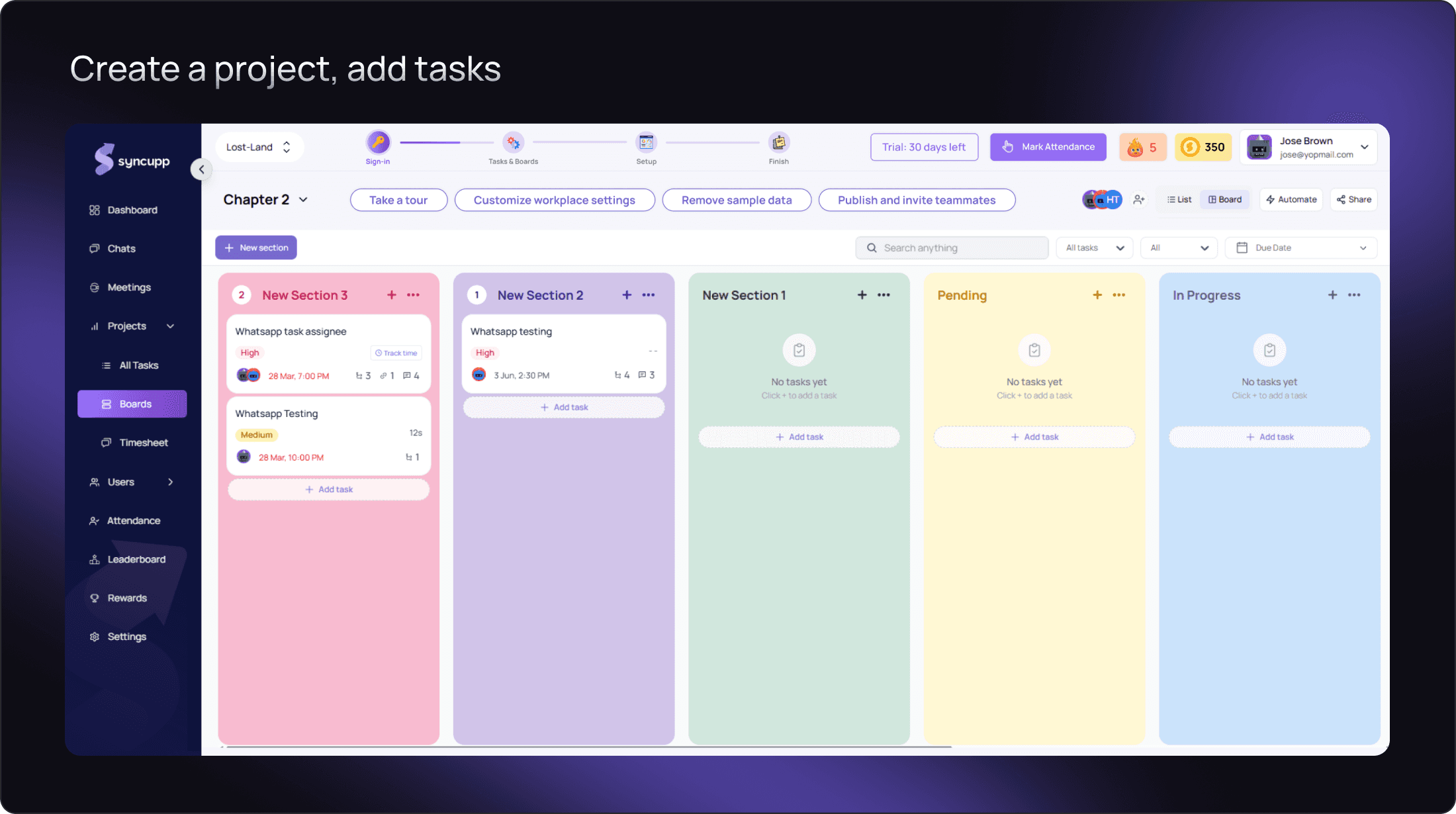
- Clear owner and due date. Every task gets one named owner, a due date and a definition of done. This targets the engagement item that has fallen furthest since 2020: knowing what is expected.
- Progress visible without asking. Status lives on a shared board, not in someone's head or a chat thread. This removes the "searching for answers" time Atlassian measured.
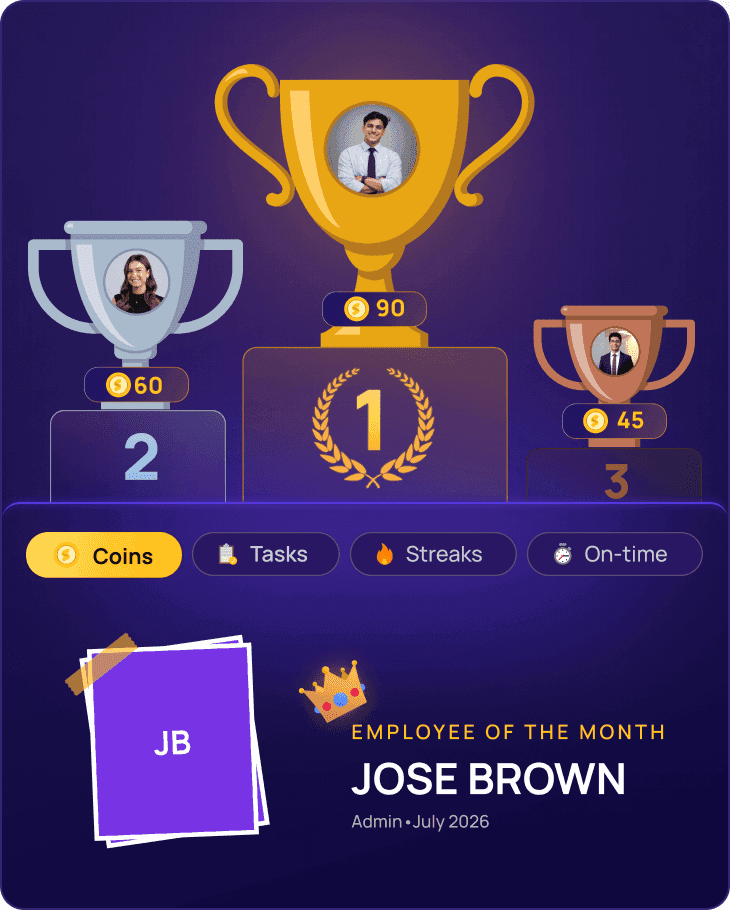
- Recognition on completion. Acknowledge finished work quickly and specifically, in public where it suits your culture. Points, streaks or a simple shout-out all count.
- Weekly review and reset. A short weekly check-in on overdue items, blockers and next priorities. Gallup's data favours weekly meaningful feedback over occasional long reviews.
How do you measure accountability on your team?
Track behaviour, not feelings. Four numbers from your task system tell you whether accountability is improving: the share of tasks with an owner and due date, the on-time completion rate, how many tasks are overdue, and how long tasks sit without an update. Review them weekly and watch the trend, not one week's figure.
| Metric | How to calculate | What good looks like |
|---|---|---|
| Task clarity rate | Tasks with one owner and a due date ÷ all open tasks | Close to 100% |
| On-time completion rate | Tasks completed by due date ÷ tasks due this week | Rising month on month |
| Overdue count | Open tasks past due date | Falling, and none older than two weeks |
| Update freshness | Days since a task's last status change | No active task silent for a week |
| Recognition frequency | Times each person's work was recognised this month | Everyone recognised at least monthly |
You can also pull these numbers with an AI assistant: connect Claude to your task board and ask it for the week's figures.
Decision checklist: is your accountability system working?
- Can anyone see who owns a task and when it is due, without asking?
- Do people update tasks where they already work (app, WhatsApp, Slack)?
- Is completed work acknowledged within a week?
- Do you review overdue tasks every week?
- Do your leaders' self-ratings on accountability match what their teams say?
If you tick fewer than four, start with step 1 of the loop. Clarity is the cheapest fix and the one the data links most strongly to engagement.
Frequently asked questions
What is workplace accountability?
Workplace accountability means people own clear commitments, report progress honestly and deliver what they agreed, by when they agreed. It depends on systems as much as character: a clear owner and deadline, visible progress, and consistent follow-up. Gallup's 2025 data shows it is the leadership skill employees rate lowest.
Are employees less clear about expectations than before?
Yes. Gallup reports that clarity about what is expected at work fell nine points among US employees from 2020 to 2025, the largest decline of any item in its engagement index. Employees with that clarity are nearly four times as likely to be engaged, which makes expectations the first thing to fix.
What causes a lack of accountability at work?
The most common causes in the data are unclear expectations, progress that is invisible without asking, little recognition, and leaders who overrate their own follow-through. Gallup found 46% of leaders rate themselves exceptional at creating accountability, but only 30% of managers agree.
How do you measure team accountability?
Use task data: the share of tasks with an owner and due date, on-time completion rate, overdue count and days since each task's last update. Review the trend weekly. These numbers are objective, cheap to collect and show whether changes to your process are working.
Does gamification work for adults at work?
It helps modestly. A 2020 meta-analysis found gamification has a small-to-medium effect on motivation (g = 0.36) and a smaller effect on behaviour, mostly in learning settings. It works best when it rewards finished, on-time work, alongside clear goals, rather than replacing them.
How much does low employee engagement cost?
Gallup estimates low engagement cost the global economy about $10 trillion in lost productivity in 2025, roughly 9% of global GDP. Global engagement fell to 20% that year, and manager engagement dropped from 27% to 22%.
Conclusion: accountability is a system, not a speech
The 2026 data is consistent. Leaders overrate their own accountability, fewer employees know what is expected of them, and teams lose a quarter of their time looking for answers. The fixes with the strongest evidence are simple: clear owners and deadlines, visible progress, regular recognition and a weekly review.
Syncupp is built around that loop for small and mid-size teams. It is not the right fit if you need a white-label client portal; for task ownership, visibility and recognition, it is.
About Syncupp
Syncupp is a gamified team management app with native WhatsApp and Slack integration that combines tasks and boards, team chat, meetings, attendance and leave, and points, streaks and leaderboards in one tool. It is built for teams of 5 to 100 people, such as agencies, accounting firms and remote teams, and costs $8 per user per month (from $5 billed yearly, up to 20 users) or $149 per month flat for unlimited users. See Syncupp pricing for every billing option.
Sources
- Gallup: Accountability Is Leadership's Greatest Weakness (Mar 2026)
- Gallup: State of the Global Workplace 2026, global data summary
- Gallup: State of the Global Workplace 2026 report page (manager engagement, $10T)
- Gallup: U.S. Employee Engagement Declines From 2020 Peak (Jan 2026)
- Gallup: Employee Retention Depends on Getting Recognition Right (Sep 2024)
- Gallup: A Great Manager's Most Important Habit (updated Feb 2026)
- Microsoft WorkLab: Breaking down the infinite workday (Jun 2025)
- Atlassian: State of Teams 2025
- Asana Anatomy of Work Global Index 2023 (Business Wire)
- PMI: Why Complex Projects Fail (press release, May 2026)
- PMI: Pulse of the Profession 2026, Driving Success in Complex Projects
- PMI: Pulse of the Profession 2025 (PDF)
- Sailer & Homner (2020), The gamification of learning: a meta-analysis
- Dominican University: Goal-setting research release (Jan 2016, PDF)
- Culture Partners: Workplace Study Reveals Crisis of Accountability