Workplace Gamification Statistics 2026: What Actually Works
Every number traced to its original study: what the research says about points, streaks and leaderboards at work, when gamification backfires, and a 7-step framework you can use this month.

On this page
- What is workplace gamification?
- Workplace gamification statistics at a glance (2026)
- Does gamification actually work at work?
- Why does engagement data matter for gamification?
- Which game elements do employees actually respond to?
- When does workplace gamification backfire?
- What actually works? A 7-step workplace gamification framework
- How do you measure whether gamification is working?
- Workplace gamification examples
- Frequently asked questions
- The bottom line
- About Syncupp
- Sources
Only 20% of employees worldwide were engaged at work in 2025, according to Gallup. No wonder managers keep asking whether points, streaks and leaderboards can fix it. Most "gamification statistics" pages recycle the same untraced numbers. This page uses only figures we traced to the original study or survey, grades how strong each one is, and ends with a framework you can apply this month.
What is workplace gamification?
Workplace gamification is the use of game elements such as points, streaks, badges, levels, leaderboards and rewards inside ordinary work: task management, training, sales or attendance. The goal is not to turn work into a game. It is to make progress visible and give people fast, fair feedback on work they already do.
The six elements you will meet most often:
| Element | What it shows | Typical use at work |
|---|---|---|
| Points | Credit for each completed action | Closing tasks, tickets or deals |
| Streaks | Consecutive days of a behaviour | Daily task updates, check-ins |
| Leaderboards | Rank against peers or teams | Sales targets, task completion |
| Badges | A milestone reached | Training, first wins, tenure |
| Levels | Cumulative progress tiers | Onboarding and skill paths |
| Rewards | Points exchanged for something real | Vouchers, time off, a team lunch |
Workplace gamification statistics at a glance (2026)
The most reliable numbers on workplace gamification come from peer-reviewed reviews, controlled experiments and large Gallup datasets, not vendor surveys. Each statistic below carries its source, year and evidence type, so you can judge which ones are safe to quote in a report, deck or article.
| Statistic | Source (year) | Evidence type |
|---|---|---|
| 20% of employees worldwide were engaged in 2025, down from 21% in 2024 | Gallup, State of the Global Workplace (2026) | Global survey, very large sample |
| Engagement was 21% in South Asia and 25% in Southeast Asia in 2025 | Gallup, State of the Global Workplace (2026) | Global survey, regional cut |
| Only 22% of employees say they get the right amount of recognition for their work | Gallup & Workhuman (2024) | Panel of ~3,500 employees |
| Well-recognised employees are 45% less likely to have left after two years | Gallup & Workhuman (2024) | Two-year tracking; association, not proof of cause |
| A review of 24 empirical studies found gamification's effects depend heavily on context and users; 13 of 22 quantitative studies reported mixed results | Hamari, Koivisto & Sarsa, HICSS (2014) | Literature review |
| Leaderboards (10 studies), points (9) and badges (9) were the most-tested game elements | Hamari et al. (2014) | Literature review |
| A leaderboard lifted performance about as much as a difficult goal did | Landers, Bauer & Callan, Computers in Human Behavior (2017) | Randomised experiment |
| A workplace game raised positive feelings among employees who bought in, and lowered them among those who did not | Mollick & Rothbard, Wharton (2014) | Field experiment plus lab study |
| 89% of surveyed employees said gamification makes them more productive; 88% said happier | TalentLMS Gamification at Work Survey (2019) | Vendor survey, ~900 respondents, self-reported: quote as perception |
| Elements employees encounter at work: badges 71%, points 59%, rewards 56%, leaderboards 51%, levels 47% | TalentLMS (2019) | Vendor survey |
| Learners who reach a 7-day streak are 3.6x more likely to complete their course | Duolingo (2022) | Company data, consumer app |
| New habits took 66 days on average to become automatic; missing one day did not significantly set people back | Lally et al., UCL (2009) | Field study |
| Knowledge workers spend 58% of their day on "work about work" and use 8.8 apps on average | Asana Anatomy of Work Index (2023) | Survey of 9,615 workers, 6 countries |
A note on what is missing: you will see claims like "X% of companies use gamification" or a precise global market size on other pages. We could not trace a credible, current primary source for either, so we left them out. Market-research estimates for gamification disagree widely.
Does gamification actually work at work?
Yes, with limits. A 2020 meta-analysis found gamification produces small but significant positive effects on learning, motivation and behaviour. An earlier review of 24 studies found the effects depend heavily on context and on the people using it. Expect a modest lift from good design, not a transformation from adding points.
Gamification helps, but the effects are small
Pooled effect size (Hedges' g) with 95% confidence interval, by outcome
Cognitive (learning)19 studies, n = 1,686
g = 0.49
Motivational16 studies, n = 2,246
g = 0.36
Behavioural9 studies, n = 951
g = 0.25
Effect size (Hedges' g); 0 = no effect
All three effects are positive and statistically significant, and all sit at or below the conventional "medium" threshold.
The Sailer & Homner meta-analysis (Educational Psychology Review, 2020) pooled 19 studies on cognitive outcomes (1,686 participants), 16 on motivation (2,246) and 9 on behaviour (951). The cognitive effect held up in the most rigorous studies. The motivational and behavioural effects were less stable, which is a reason to measure your own results rather than assume them.
Two design choices made a measurable difference to behaviour:
- Competition combined with collaboration beat no social interaction, and in the motivation subsplit it outperformed competition alone. In practice: a team goal plus individual scores, not a pure ranking.
- A theme or story ("game fiction") was linked to a significant effect on behaviour; without it, the effect was not significant.
Leaderboards work through goal setting. In the Landers, Bauer & Callan experiment (2017), people shown a leaderboard performed about as well as people given difficult goals. The authors suggest participants silently set their own goal at or near the top of the board. Treat a leaderboard as a goal-setting tool, and make sure the goal it implies is one you actually want.
One honest caveat: much of the controlled research comes from learning and training settings. Field evidence from day-to-day task management is thinner, so the framework later in this post leans on mechanisms that replicate across settings: goals, feedback, recognition and consent.
Why does engagement data matter for gamification?
Gamification is usually a response to low engagement and thin recognition, and both are widespread. Gallup's 2026 report puts global engagement at 20%, and only 22% of employees say they get enough recognition. Engagement gaps show up in hard business results, which is why even small motivational gains are worth designing for.
Gallup's 11th Q12 meta-analysis (2024) covers 183,806 business units and 3.35 million employees across 90 countries. It compares the most and least engaged quarters of teams, so it shows what engagement is associated with, not what any single tactic will deliver.
Highly engaged teams outperform on every outcome Gallup tracks
Median difference, top- vs bottom-quartile engaged business units. Highlighted: profitability, the outcome most owners track first.
Three numbers matter most for teams in Syncupp's core markets:
- Asia is not an exception. Engagement was 21% in South Asia and 25% in Southeast Asia in 2025 (Gallup).
- Recognition is the cheapest gap to close. Only 22% of employees feel adequately recognised, and well-recognised employees were 45% less likely to have left two years later (Gallup & Workhuman, 2024). Points and rewards are, at heart, a system for making recognition frequent and specific. More data in our workplace accountability statistics.
- Tool sprawl eats the time you want to reward. Knowledge workers spend 58% of their day on "work about work" and juggle 8.8 apps (Asana, 2023). A points system bolted onto yet another app adds one more place to check. Gamification works best inside the tool where tasks already live.
Which game elements do employees actually respond to?
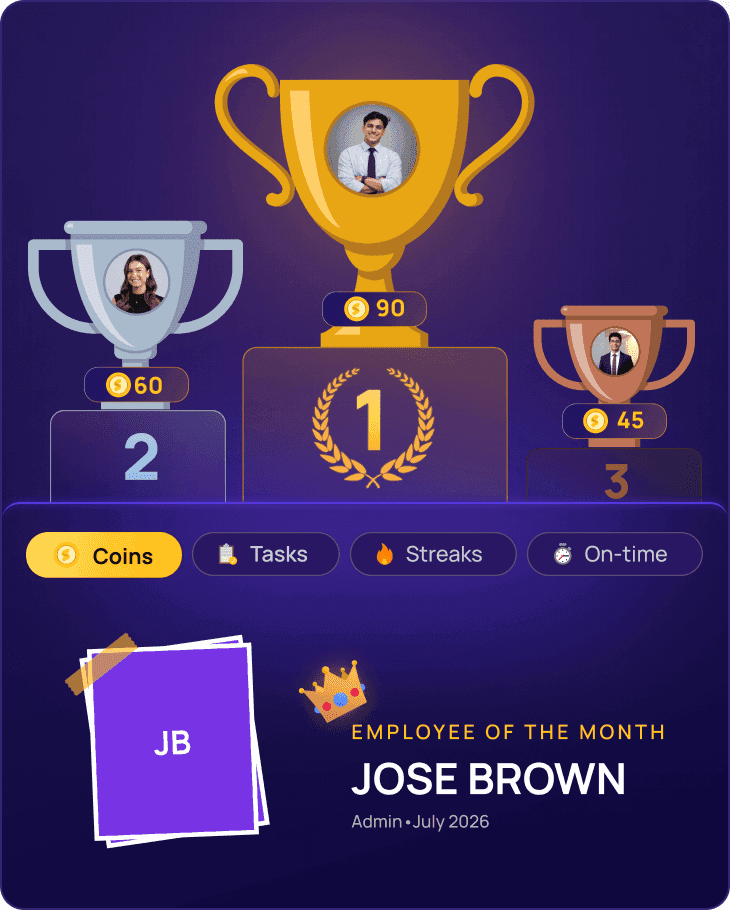
In TalentLMS's 2019 survey, employees ranked rewards as the most motivating element, followed by badges, points, leaderboards and levels. Research adds nuance: leaderboards act like goal setting, streaks build habits when they forgive a missed day, and points motivate only when they track work that matters.
Rewards. Ranked first for motivation, yet only 56% of respondents saw them at work (TalentLMS, 2019). Points that convert into something real, chosen by the team, close that gap.
Streaks. Duolingo learners who reach a 7-day streak are 3.6 times more likely to finish their course. When Duolingo let learners hold two "streak freezes", daily active learners rose 0.38% without people taking more days off (Duolingo, 2022). That matches habit research: in a UCL study, missing one day did not significantly hurt habit formation, but very inconsistent people never formed the habit. Design streaks with a grace day.
Leaderboards. Effective as an implicit goal (Landers et al., 2017), and the most-studied element in the research (Hamari et al., 2014). They are also the element most likely to backfire, which the next section covers.
Badges and levels. The most commonly seen elements (badges at 71%) but ranked lower for motivation than rewards. Useful for onboarding milestones; weak as a daily driver.
When does workplace gamification backfire?
Gamification backfires when it is imposed, when it rewards activity instead of outcomes, or when rankings expose the same people at the bottom every week. In Wharton's field experiment, a sales game raised positive feelings among employees who bought in and lowered them among those who did not. Consent and fairness decide the outcome more than the mechanics.
In Mollick & Rothbard's study, several hundred salespeople played a basketball-themed game shown on big screens and leaderboards. Consent was measured with three questions: did people follow the game, understand the rules, and think it was fair. Employees who did not consent felt worse about their jobs and showed a slight drop in performance. Consenters felt better, but showed no measurable sales gain. A follow-up lab study found that legitimacy and a sense of individual choice drive consent (SSRN paper).
The six failure modes we see most often:
- Mandatory fun: the game is announced, not agreed, and the rules are unclear.
- Vanity metrics: points for messages sent or logins, so people optimise the number, not the work.
- Unverified completion: tasks marked done that are not done. Fix it with an approval step before points count.
- Permanent rankings: an all-time leaderboard the same three people always top.
- Brittle streaks: one missed day wipes out weeks of progress.
- Rewards nobody wants: prizes picked by management without asking the team.
Gamification pays off only when people opt in and points reward verified work
- Gamed scoreboardPeople play along but optimise the number, not the work.
- Sustainable gamificationBuy-in plus verified work: where the research gains show up.
- Mandatory funResentment plus busywork: the worst of both.
- Resented scorekeepingFair metrics, no buy-in: morale drops for those who opt out.
- Activity (logins, messages)
- Verified outcomes (approved tasks)
Employee consent
What earns points
Most failed programmes sit in the bottom row or the top-left box. Move up by getting buy-in, and right by tying points to approved work.
What actually works? A 7-step workplace gamification framework
Start with one behaviour you already need, such as closing tasks by their due date. Reward it with points, make progress visible and verify completion. Let people opt in, pair individual scores with a team goal, and review after about 66 days, the average time a new habit takes to become automatic.
- Pick one behaviour tied to an outcome. "Tasks closed by due date" or "daily update posted before 6 pm", not "time spent in the app".
- Explain the rules and ask for buy-in. Mollick and Rothbard's three consent tests are a ready-made checklist: people follow it, understand the rules, and think it is fair.
- Reward verified work, not activity. Points count only after a manager or reviewer approves the task.
- Combine competition with collaboration. A shared team target plus individual scores, the combination that performed best in the 2020 meta-analysis.
- Use streaks with a grace day. One missed day should pause a streak, not erase it.
- Keep rewards small, real and chosen by the team. A half-day off, a team lunch or a voucher beats a prize nobody asked for.
- Reset and review on a cycle. Reset leaderboards weekly or monthly so new people can win, and review results after roughly ten weeks (66 days).
Decision checklist before you launch
- We can name the one behaviour we are rewarding and the outcome it drives.
- Points are tied to approved or verified work.
- Everyone has seen the rules, and we asked whether they seem fair.
- There is a team goal, not just an individual ranking.
- Streaks forgive at least one missed day.
- Rewards were chosen with the team.
- Leaderboards reset on a fixed cycle.
- We know which metrics we will check at week 10.
How do you measure whether gamification is working?
Measure the behaviour you rewarded and the outcome it was meant to move, before and after launch, over at least ten weeks. Track participation and fairness too: a rising score with falling opt-in or a spike in rejected approvals means people are gaming the system rather than doing better work.
| Metric | What it tells you | Warning sign |
|---|---|---|
| On-time task completion rate | Whether the core behaviour improved | Flat after 10 weeks |
| Share of tasks updated within 24 hours | Whether visibility improved | Updates bunch up before reviews |
| Participation or opt-in rate | Whether people consent to the game | Falling month on month |
| Approval rejection rate | Whether points reward real work | Rising rejections |
| Spread of points across the team | Whether the board motivates beyond the top three | Same names on top every cycle |
| Pulse question: "The system is fair" | Consent, as in the Wharton study | Under half agree |
Workplace gamification examples
The best-documented examples are the ones covered above: Duolingo's forgiving streaks, Wharton's sales game and the leaderboard experiment. Companies rarely publish their own data. Here is how the same principles look inside a team's daily task tool.
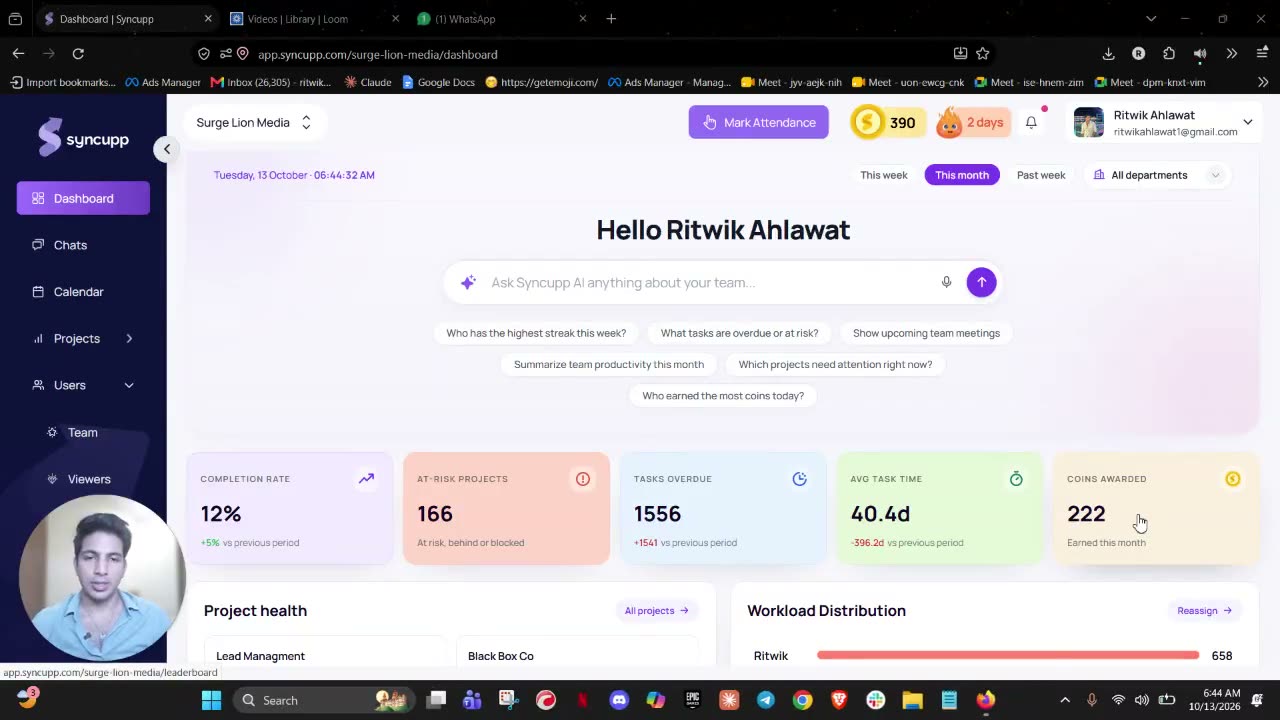
Gamified task management. In Syncupp, points are earned for completed tasks, approvals gate those points, streaks reward consistent updates, and a rewards section turns points into something the team chose. Tasks can be created or updated by chatting with an AI agent in the app, on WhatsApp or on Slack, with voice notes on WhatsApp and in the app, so updating work is quick enough to become a daily habit. See how to manage your team on WhatsApp without losing tasks, or set up the WhatsApp task integration.
Frequently asked questions
Does gamification increase productivity at work?
The best evidence shows small, positive effects, not large ones. A 2020 meta-analysis found effects of g = 0.25 on behaviour and g = 0.36 on motivation. Self-reported surveys look rosier: 89% of TalentLMS respondents said gamification makes them more productive. Measure your own team's on-time completion rate before and after to know for sure.
What percentage of companies use gamification?
There is no credible, current figure. Most quoted percentages trace back to old analyst predictions or vendor surveys with undisclosed samples. The closest traceable data point is employee-side: in TalentLMS's 2019 survey, 43% of respondents had not noticed any gamification at work. Treat any precise adoption figure without a named source with suspicion.
Are leaderboards bad for team morale?
Not inherently. A 2017 experiment found leaderboards work like difficult goals. They hurt morale when they are imposed, permanent, or reward activity instead of results. Reset them on a cycle, pair them with a team goal, show personal bests, and ask the team whether the system feels fair. Wharton's research ties the outcome to consent, which includes perceived fairness.
What is the best gamification element for a small team?
For a team of 5 to 50 people, start with points for approved task completions plus a forgiving streak for daily updates. Employees ranked rewards as the most motivating element, so let points convert into small rewards the team picks. Add a weekly-reset leaderboard only once people have bought in.
How long does it take to see results from gamification?
Plan for about ten weeks. Habit research from UCL found new behaviours took 66 days on average to become automatic, with wide individual variation. Early spikes in activity are common and can fade, so judge the programme on the week-10 numbers for your target behaviour, not the first week's excitement.
Does gamification work for remote and hybrid teams?
Yes, and it can matter more there, because progress is otherwise invisible. Remote teams benefit most when points, streaks and leaderboards live inside the tool where work is assigned and discussed, so no one has to check another app. Pair visible individual progress with a shared team target to keep it collaborative.
The bottom line
Workplace gamification is not magic, and the honest statistics say so: effects are real but small, and imposed games can hurt. The upside is that the conditions for success are simple. Reward one meaningful, verified behaviour, get buy-in, pair competition with a team goal, forgive a missed day, and measure after ten weeks.
About Syncupp
Syncupp is a gamified team management app with native WhatsApp and Slack integration that combines tasks, team chat, meetings, attendance and leave, and approvals with points, streaks, leaderboards and rewards. It is built for small and mid-size teams of 5–100 people, is used by 160+ paying teams across India and Southeast Asia, and costs $8 per user per month (from $5 billed yearly, up to 20 users) or $149 per month flat for unlimited users. See Syncupp pricing.
Sources
- Gallup, State of the Global Workplace: 2026 Report
- Gallup, Q12 Meta-Analysis, 11th edition (2024)
- Gallup & Workhuman, employee recognition research (2024)
- Sailer & Homner, "The Gamification of Learning: a Meta-analysis", Educational Psychology Review (2020)
- Hamari, Koivisto & Sarsa, "Does Gamification Work?", HICSS (2014), abstract
- Hamari, Koivisto & Sarsa (2014), full paper PDF
- Landers, Bauer & Callan, "Gamification of task performance with leaderboards", Computers in Human Behavior (2017)
- Mollick & Rothbard, "Mandatory Fun: Consent, Gamification and the Impact of Games at Work", SSRN (2014)
- Knowledge at Wharton, "People Love Games, but Does Gamification Work?"
- TalentLMS, 2019 Gamification at Work Survey
- Duolingo, "How Duolingo's streak builds habit" (2022)
- UCL, "How long does it take to form a habit?" (2009)
- Asana, Anatomy of Work Global Index 2023 (Business Wire)
